A hotel is not just a place to sleep. It is, for the duration of a guest's stay, a temporary home in a city or place they have travelled to reach. What a hotel communicates about that place through its design, its materials, and its art shapes how guests understand and remember the destination itself.
This is why art matters in a hotel in a way that goes beyond aesthetics. A thoughtfully chosen work on the wall of a bedroom or lobby does something a beautiful piece of furniture cannot: it creates a direct connection to a human sensibility rooted in a specific place. It tells guests, implicitly, that they are somewhere, not just anywhere. We explored this idea in depth in our piece on the sense of place in hospitality, and it applies with particular force to hotels, where guests spend hours in a space rather than passing through it.
The challenge, of course, is scale. A restaurant might need a dozen carefully chosen works. A hotel might need hundreds, spread across a lobby, corridors, bars, restaurants, and every individual room. At that volume, the economics of sourcing and buying original art become genuinely difficult. The question most hotel owners and interior designers face is not whether to have art, but how to approach it without defaulting to the mass-produced and the generic.
This guide covers the options honestly, from lobby to bedroom, from original commissions to smart reproduction strategies and introduces a newer model that changes the calculation entirely.
Why Art Is One of the Highest-Impact Design Decisions You'll Make
Of all the design decisions a hotel makes, art is unusual in that it operates simultaneously on multiple levels. It shapes the visual quality of a space. It communicates something about the hotel's personality and values. It gives guests something to engage with, talk about, and photograph. And it contributes, in ways that are harder to quantify but no less real, to the emotional register of a stay.
Guests who stay in hotels with considered, location-specific art are more likely to describe their experience as distinctive, more likely to mention specific details in reviews, and more likely to return. The research on the relationship between physical environment and guest satisfaction consistently points in the same direction: the finishing layer (the art, the objects, the things that reward close attention) disproportionately shapes how a stay is remembered.
The inverse is also true. Generic art, the kind of mass-produced abstract canvases and commercial prints that appear in thousands of hotel rooms simultaneously, does not merely fail to add value. It actively signals that the hotel has not thought carefully about its space. Guests may not be able to articulate why a room feels impersonal, but the absence of genuine character is something they feel.
Lobby, Corridor, Bedroom: What Works Where
Different parts of a hotel have different requirements, and the art strategy that serves one space well will not necessarily translate to another. The most effective hotel art programmes treat each zone on its own terms.
The lobby deserves the same level of curatorial attention as a restaurant or even a gallery. It is the first thing guests encounter and the space they pass through repeatedly. A single powerful work such as a large-scale painting, a sculpture, or a site-specific installation can anchor an entire hotel's identity. This is the place to invest in genuine originality and to take the kind of curatorial risk that a bedroom wall cannot support.
And "art" in the lobby need not mean paintings alone. Hotels that do this well understand that a sense of place can be communicated through many registers: local archaeological artefacts, examples of regional craft and artisanship, objects that carry the history and character of a neighbourhood. A ceramicist whose practice is rooted in the local tradition, a textile maker working in a regional technique, a piece of found architecture from the building's history… all these can be as powerful as any painting, and more specific to place than most.
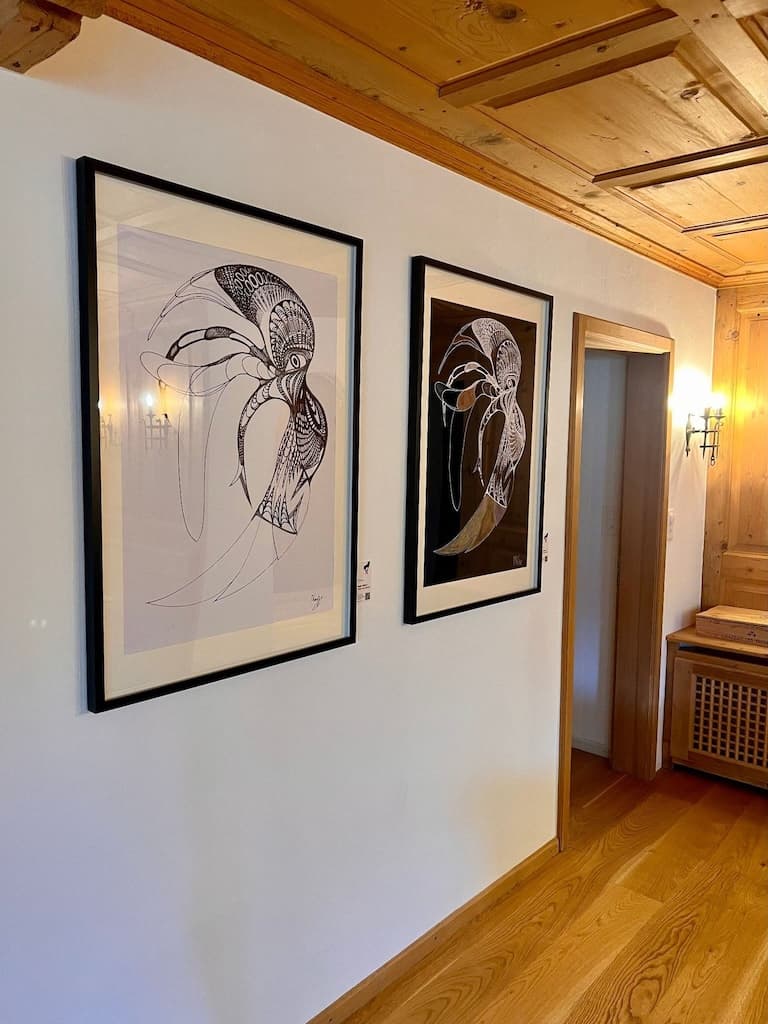
Corridors are transitional spaces — guests move through them quickly, but they offer a significant cumulative opportunity. A coherent series of works across a corridor or floor creates a narrative that guests absorb over the course of their stay, even without stopping to look. Photography, printmaking, and smaller works on paper all perform well here. Consistency of framing and hanging height is more important in corridors than almost anywhere else; visual disorder in a transitional space reads as institutional.
Bedrooms present a different set of constraints, but also a genuine strategic advantage. Because each guest only sees their own room, repetition of the same artwork across multiple rooms is not a problem in the way it would be in a public space. A guest in room 14 has no idea what is on the wall of room 22. This makes the bedroom the most tractable part of the hotel art challenge at scale, and opens up reproduction strategies that would be inappropriate in the lobby.
Original Art vs Prints: What's the Actual Difference for Guests?
The honest answer is: it depends on what the guest can tell. Original art carries something that a reproduction cannot — the physical evidence of a human hand, the texture of paint or pigment, the specific quality of a unique object. In a lobby or a restaurant, where guests spend time looking closely, this difference registers. In a bedroom, where a guest glances at a print on the wall from across the room, the distinction matters far less.
What matters more than originality in every context is quality and specificity. A high-quality, site-specific limited edition print by a local artist is infinitely preferable to an original but generic abstract canvas. The question to ask is not "is this an original?" but "would a guest know this is here because someone thought carefully about this place?"
The failure mode to avoid is the one that plagues the hospitality industry at scale: artwork that has no connection to the place, chosen purely for its inoffensiveness and its price point. We have seen the results. An oversized triptych of desaturated botanical prints in a hotel celebrating its industrial heritage. Abstract canvases in colours chosen to match the carpet. Art that exists as a visual placeholder rather than a considered element of design. The disconnect between the spirit of a place and what hangs on its walls is more painful (and more legible to guests) than most hotel owners realise.
How to Choose Art That Fits Your Brand and Your Guests
For hotels operating at scale, one legitimate solution is to acquire the rights to an artwork outright and reproduce it across a property or portfolio. Some hotel groups have done this effectively: an artist creates a work, the hotel licenses the image for unlimited reproduction, and prints are produced at whatever volume the portfolio requires. At its best, this model gives every room in a hotel a piece of genuine artistic provenance without the cost of individual original works.
It is not, however, a casual undertaking. Licensing agreements between hotels and artists are legal documents that require proper negotiation, and the reproduction process — print quality, substrate, framing, sizing — demands expertise to execute well. More importantly, the artwork has to be exactly right. When it is, the result is coherent and distinctive. When it is not, when the licensed image sits awkwardly against the hotel's architecture, or fails to connect with the spirit of the place, the effect is the opposite of what was intended. Multiplied across hundreds of rooms, a poor choice becomes a defining feature of the property in the worst possible way.
A more elegant version of this approach is to commission an artist specifically for the purpose of reproduction. Rather than acquiring rights to an existing work, the hotel engages an artist to create something designed from the outset to be reproduced as limited edition prints — artwork made for this place, this hotel, this context. Most professional artists working in the hospitality space understand this model and can structure the collaboration accordingly. Starting the conversation with reproduction intent at the outset saves considerable renegotiation later.
What Boutique Hotels Do Differently (And What You Can Steal)
The most instructive examples of hotel art done well tend to come from independent and boutique operators, precisely because they have the flexibility to treat their location as the brief rather than applying a standardised formula across a portfolio.
Supercity Aparthotels, a London-based group with properties across the UK, offers a useful case study in how to scale an art programme without sacrificing specificity. For two of their London properties (The Chronicle and The Rosebery) they commissioned artist Elizabeth Harper to create bespoke artworks developed in close collaboration with the company's creative director. The brief was "sophisticated and playful," and Harper's approach (grounded in classical composition and then developed in a distinctive personal style tailored to each brief) produced works that feel genuinely specific to each property rather than interchangeable across the portfolio.
The lesson is not that every hotel needs to commission a bespoke artist for every property. It is that the conversation between a hotel and an artist, when it starts with a genuine brief rooted in the character of the place, produces results that no amount of catalogue browsing can replicate. And that artists who work in the hospitality space are often far more accessible, and far more interested in these collaborations, than hotel owners assume.
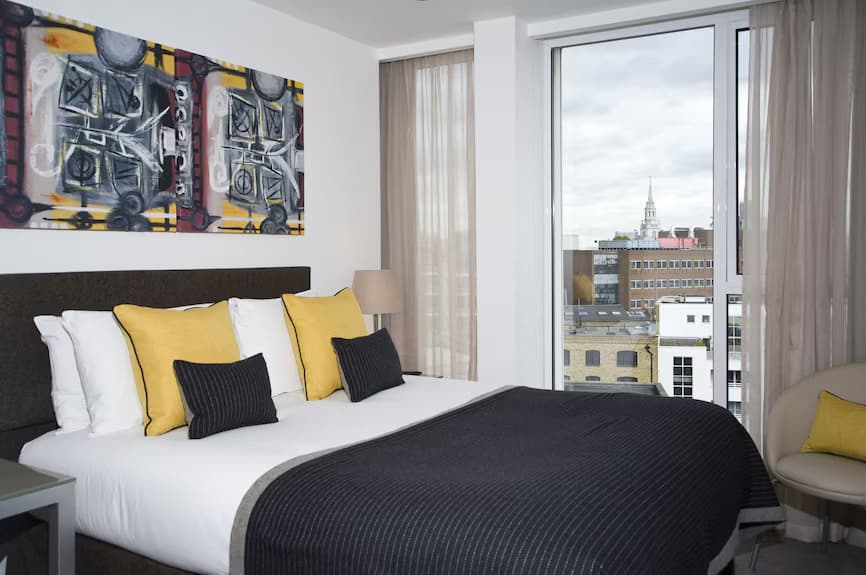
Image credit: Supercity Aparthotels and Hotels.com.
Where Do Hotels Actually Find Good Art? (The Real Answer)
The honest answer is that there is no single channel, and the best hotel art programmes tend to use several in combination. Some practical starting points:
- Art fairs with a hospitality focus. Events like the Affordable Art Fair and The Other Art Fair provide direct access to a wide range of artists and price points, with the significant advantage of being able to see scale and quality in person. For a hotel owner or interior designer sourcing for multiple spaces, a day at a fair is often more productive than weeks of online browsing.
- Local galleries and artist-run spaces. These exist in almost every city and carry curatorial knowledge that is genuinely useful. A conversation with a local gallerist about what you're looking for — including volume, budget, and the specific character you're trying to create — will often produce better results than independent searching.
- Art school graduate shows. Every summer, art schools exhibit graduating students' work. These are discovery opportunities that combine fresh talent, accessible prices, and the possibility of establishing early relationships with artists who will go on to significant careers.
- Direct artist outreach. For commissions or licensed reproduction, a direct approach to artists whose work fits your brief is often the most direct route. Instagram has made this considerably easier: search by location and style to find practitioners working in a way that connects to your context.
- Hospitality art platforms. A newer generation of services exists specifically to connect hotels and other hospitality venues with artists, managing the curation, logistics, and ongoing display. PickArt is one of them.
The PickArt Model: Curated Local Art for Hospitality, With No Upfront Cost
We built PickArt to solve precisely the problem this article has been exploring: how to get original, locally rooted art into hospitality spaces at scale, without the capital investment, the curatorial overhead, or the operational complexity that typically makes it difficult.
We work with hotels, restaurants, cafés, coworking spaces, and aparthotel groups to curate and supply original artworks selected from our network of local artists in every city where we operate. Works are chosen to match each venue's atmosphere, palette, and character by location, by room type, by the specific brief a property brings to us. They arrive ready-to-hang and fully insured. Alongside each piece, we provide a discreet QR label that invites guests to learn about the work and the artist, and to purchase if they choose to. We handle the transaction, the certificates, the delivery to the buyer, and the replacement artwork.
Venues pay nothing upfront. The collaboration is built around shared upside: we earn from sales, and your venue earns a commission on every artwork purchased by a guest. When you earn from premium nightly rates that the original art allows, we share that upside with the artist, too.
For hotels that prefer to work with prints rather than originals (whether for reasons of budget, scale, or practical durability in high-turnover rooms) we can also support that conversation: connecting you with artists from our network who are open to licensed reproduction, and helping structure those relationships appropriately from the outset.
The result is a hotel that tells a genuine story about its place, through the work of artists who actually live and work there, without requiring a dedicated art budget or a curatorial team to manage it. For hotel owners who have been putting off the art question because it felt complicated or expensive, it is worth knowing that it doesn't have to be either.