
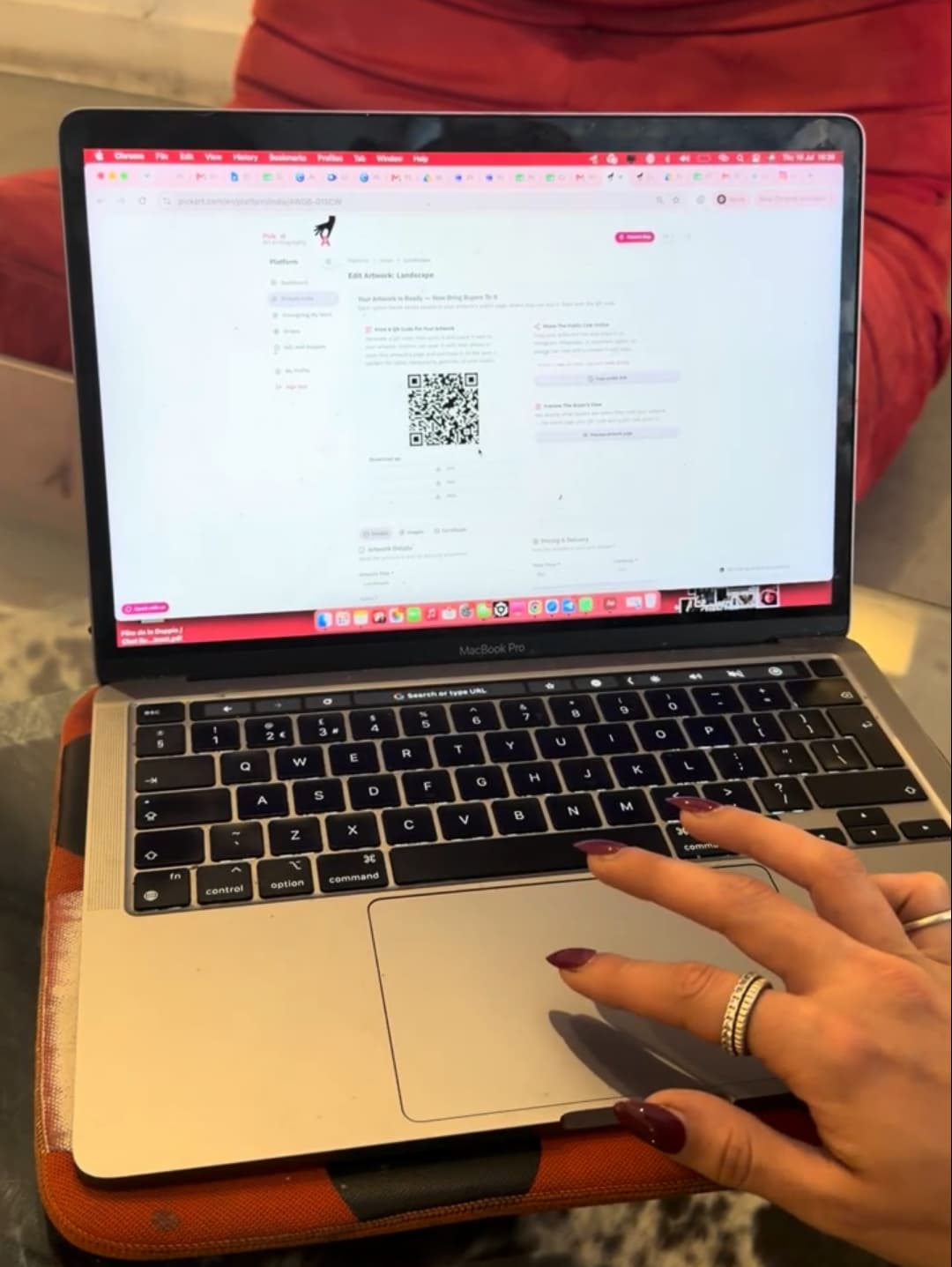
Selling art online is often talked about as though there is one perfect platform artists simply need to find. In reality, Instagram, Etsy and QR codes all do quite different jobs.
Instagram can help people discover you and your practice. Etsy provides a marketplace where people are already browsing with the intention to buy. QR codes can help someone who has already encountered your work physically move from seeing it to learning more or purchasing it online.
As a curator, I think that distinction matters. Artists are often encouraged to be everywhere at once: post consistently, build a website, maintain an online shop, attend exhibitions, answer enquiries and somehow still find time to actually make the work.
Instead of asking which platform is universally the "best", it is more useful to ask: where are people discovering your work, and what is the easiest next step for them if they want to buy it?
Here is how three increasingly common approaches compare.
Instagram vs Etsy vs QR Codes at a Glance
| Etsy | QR codes | ||
|---|---|---|---|
| Best for | Discovery and building an audience | Marketplace discovery and checkout | Converting physical interest into online action |
| Built-in audience | Yes | Yes | No |
| Direct selling | Possible, but requires a clear purchase route | Yes | Depends on where the QR leads |
| Artist control | Medium | Medium | High, depending on the linked platform |
| Setup required | Relatively low | Medium | Low to medium |
| Best suited to | Artists building a following around their practice | Artists with work suited to marketplace browsing | Artists exhibiting in physical spaces |
| Main limitation | Attention doesn't automatically become a sale | Competition, fees and a general rather than art-specific marketplace | Doesn't create an audience by itself |
The important point is that these methods aren't necessarily competitors. An artist might use Instagram to build an audience, Etsy or another checkout system to sell online, and QR codes to connect a physical exhibition with that digital sales journey.
How to Sell Art on Instagram
Instagram has become an important part of how artists communicate their practice. It can function as a portfolio, studio diary, networking tool and discovery platform all at once.
For artists whose work is visually distinctive or whose process translates well to video, Reels and other short-form content can introduce the work to people who would never otherwise encounter it.
But being discovered on Instagram and selling through Instagram are not the same thing.
If you're using Instagram with sales in mind, make it easy for someone interested in a piece to answer some basic questions:
- Is this work available?
- What is the title, size and medium?
- How much does it cost?
- Where can I see more information?
- How do I actually buy it?
Artists sometimes hesitate to make prices and availability prominent because they don't want their feed to feel overly commercial. You don't need to turn every post into a sales post. But if somebody has decided they love a work, making them search through your account or send several messages just to find out whether they can afford it creates unnecessary friction.
Can You Sell Art on Instagram Without a Website?
Yes, particularly when you're starting out. Artists regularly use Instagram to generate enquiries and arrange purchases directly.
The difficulty comes as the number of works and enquiries grows.
A buyer might discover a painting in a Reel, visit your profile, search for information about it, DM you to ask whether it's available, wait for a response and then need separate instructions for payment or delivery.
That can work perfectly well when sales are occasional and you enjoy communicating directly with buyers. But it also means you become the sales infrastructure.
A dedicated artwork page, online shop or other direct purchase route can reduce those steps without requiring you to stop using Instagram for the part it does particularly well: discovery and storytelling.
How to Sell Art on Etsy
Etsy solves a different problem.
Rather than first requiring an artist to build an audience from scratch, it puts work inside a marketplace where people are already searching for things to buy.
For an artist, the basic journey is relatively straightforward: create a shop, upload individual listings with images and information, set prices and delivery options, and allow Etsy to handle the checkout.
That can make Etsy particularly attractive for artists selling prints, editions, illustrations and other work that can be listed and fulfilled relatively consistently.
There are also obvious advantages for buyers. They are purchasing through a platform they may already recognise and trust, rather than having to arrange a transaction directly with an artist they have only just discovered.
It is worth remembering, though, that Etsy isn't a platform designed specifically for selling art. Original artworks sit alongside everything from jewellery and homeware to vintage objects and craft products.
That broad audience can be a strength, but it also means the platform isn't necessarily designed around the particular considerations involved in discovering and buying original art.
The story behind the work, the artist's wider practice, scale, materials and context can all matter when somebody is considering an original artwork, particularly at a higher price point.
The Trade-Off With Etsy
Access to a marketplace also means competing within one.
Your work sits alongside a huge volume of other products and artworks, and visibility can depend on search optimisation, reviews, pricing, photography and the marketplace's own systems.
There are also fees associated with selling through Etsy, and artists have less control over the overall buyer experience than they would through their own website. Because Etsy is a broad ecommerce marketplace rather than a dedicated art platform, the buying journey has to work across thousands of different product categories rather than being designed specifically around purchasing art.
That doesn't make it a poor option for artists. For prints, editions and certain original works, the combination of built-in discovery and familiar checkout can be incredibly useful.
It simply means it is worth asking whether the way the platform sells matches the way your particular work is bought.
What About QR Codes for Selling Art?
QR codes become interesting when the starting point isn't the internet at all.
Imagine somebody encounters your painting while having coffee, visiting an Open Studio, staying in a hotel or walking around an exhibition. They like it, but you aren't there to speak to them.
What happens next?
They could photograph the label. They could search your name. They could follow you on Instagram and message later. They could ask a member of staff who may or may not know whether the work is for sale.
Or they could scan something beside the artwork and immediately reach the information they need.
This is where QR codes can be genuinely useful.
The QR code itself isn't really the important part. What matters is where it takes the viewer.
A useful artwork page might include:
- The artist's name and biography
- Title, medium and dimensions
- Price and availability
- Additional images or information
- A clear enquiry or purchase option
This creates a bridge between physical discovery and digital purchasing.
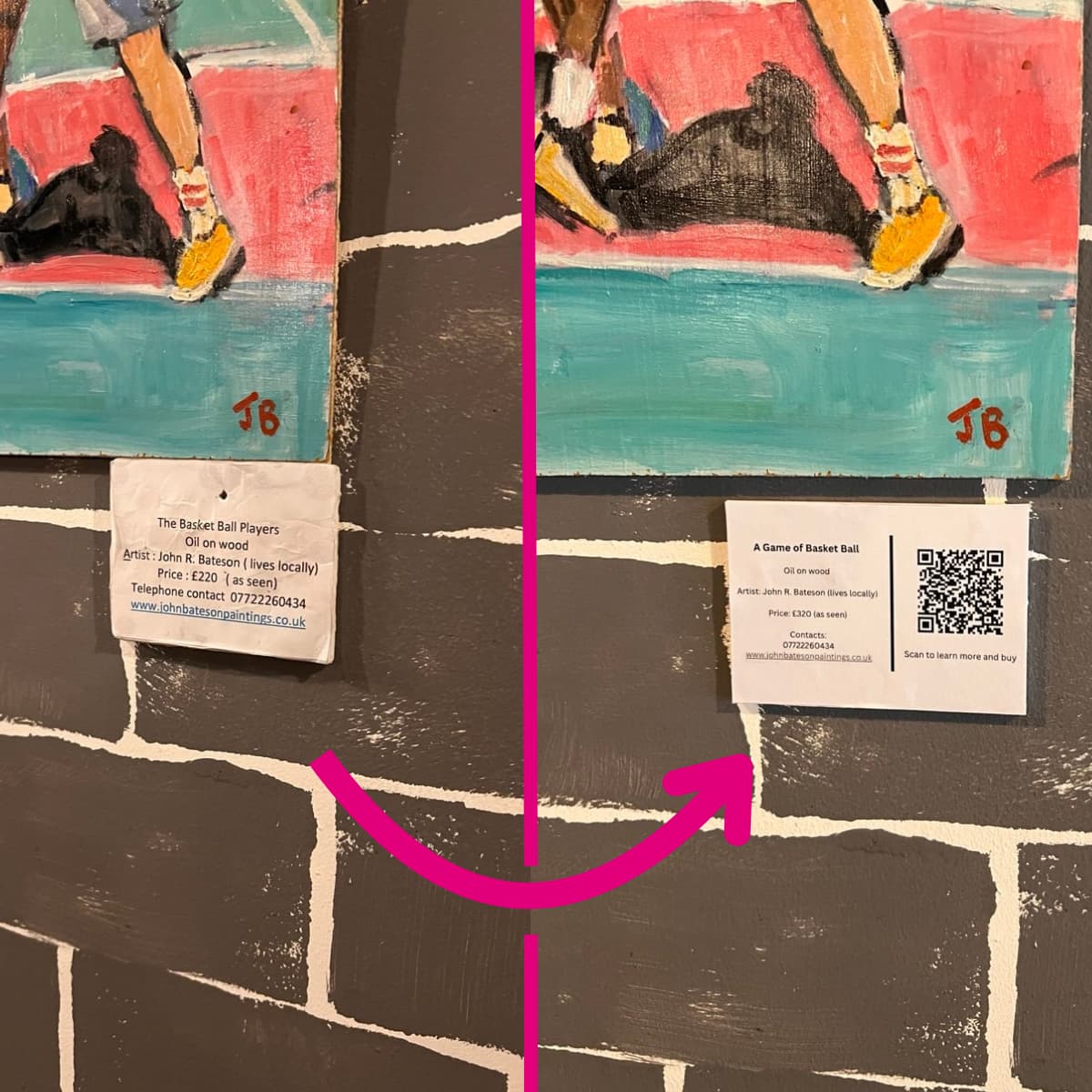
It is also important to recognise what QR codes don't do. A QR code won't generate an audience for you. If nobody sees the physical artwork, there is nobody there to scan it. They work best when the artist has already secured the valuable part: someone's attention.
If you're interested in exhibiting work outside traditional gallery spaces but haven't secured a placement yet, we'd recommend starting with Can I Exhibit My Art in Cafés, Hotels or Shops?, which explores finding suitable hospitality spaces, approaching them professionally and building relationships with venue owners.
You can also read Can I Exhibit My Art Without a Gallery? for a broader look at alternative routes to exhibiting your work.
If you already have work on display, How to Sell Art in Cafés and Restaurants goes deeper into pricing, labelling and using QR codes to turn that visibility into sales.
Where PickArt Fits
This gap between physical discovery and purchasing is something I've become increasingly interested in through my work as a curator at PickArt.
More broadly, PickArt's model seeks to streamline the journey between discovering an artwork and actually buying it.
There can be surprisingly many small hiccups in that process. A buyer doesn't know whether the work is available. They can't find the price. They need to track down the artist. They have to ask venue staff. They send an enquiry and wait for a response. Or they simply intend to look the artist up later and forget.
None of those things necessarily sounds like a major obstacle individually, but together they can create a lot of friction at exactly the moment someone is interested in a work.
With PickArt's wider model, we place artworks in hospitality and other public-facing spaces and connect those physical works to a digital purchasing journey.
PickArt Indie takes the same principle and makes it available to artists who arrange their own placements.
An artist showing work in a café, hotel, restaurant, studio, workplace, fair or other public-facing space can create an individual artwork page and connect it to the physical piece using a QR label. PickArt provides the artwork page, checkout and buyer-management infrastructure.
For me, the interesting part isn't really the QR code itself. It's what happens after somebody has decided they like the work.
The aim is to remove some of the unnecessary steps between "I love this" and "I'd like to buy it", while still giving someone enough information and context to feel confident purchasing an artwork.
That doesn't make QR codes, or PickArt, the best solution for every artist. If all of your sales happen online and you don't exhibit physically, Instagram, Etsy, another marketplace or your own website may be much more important.
But if people are already encountering your work in the real world, it can provide a way to connect that moment of discovery with a more straightforward digital sales process.
So, What Is the Best Way to Sell Original Art Online?
It depends on where the sale begins.
If You Need More People to Discover Your Work
Instagram can be particularly valuable because content can introduce both your work and your personality to new audiences.
If You Want Access to People Already Browsing for Products
A marketplace such as Etsy may make sense, particularly for prints, editions and easily shipped work.
If People Already Encounter Your Work Physically
A QR-linked artwork page can shorten the journey between seeing the work and finding out how to buy it.
If You Already Have an Engaged Audience
Your own website or direct shop may give you greater control over how your work is presented and sold.
For many artists, the best approach will be a combination.
Someone might discover your studio practice through an Instagram Reel, see your work several months later in a local exhibition, scan the QR beside a painting and purchase it online. Another buyer might find the same artist while searching Etsy for a print.
Those aren't conflicting strategies. They are different entry points into the same artist's practice.
Think About the Journey, Not Just the Platform
When advising artists, I think it's easy to become overly focused on individual platforms: Should I be on Instagram? Do I need Etsy? Should I build a website?
A better exercise is to trace the buyer journey.
Where do people currently encounter your work? What information do they have at that moment? What would they have to do next to buy it?
Then look for unnecessary steps.
If people regularly discover you on Instagram but can't tell what's available, improve that journey.
If Etsy is bringing you buyers, invest in your listings there.
If you're getting your work onto walls but relying on visitors to remember your name and contact you days later, consider creating a direct digital route from the artwork itself.
You don't necessarily need another platform. You need the right infrastructure for the way people already encounter your art.
From my perspective as a curator, that's one of the most important things to consider. Selling art isn't only about generating more visibility. It's also about making sure that when genuine interest does happen, the route from discovery to purchase is clear, trustworthy and as frictionless as possible.
That's something we're thinking about constantly at PickArt, but it's a useful principle regardless of which tools or platforms an artist ultimately chooses.
Already showing your work in a café, studio, fair or exhibition? Explore PickArt Indie to create a QR-linked artwork page and make it easier for interested viewers to discover and purchase your work.