
Selling art in person is about more than simply putting your work on a wall and hoping the right person sees it.
Whether you are taking part in an open studio, exhibiting in a group show, selling art at an art fair or displaying work in a café or other public space, you need to think about the full journey a potential buyer takes. They have to notice the work, understand what they are looking at, find the price, feel confident enough to buy and know exactly what to do next.
The good news is that you do not need to become a pushy salesperson to make that happen. Some of the most effective changes are practical ones: clearer pricing, better presentation, accessible information and an easy way to purchase.
This guide covers how to sell art in person, from preparing your work and displaying it effectively to speaking with potential buyers, taking payment and following up after the event.
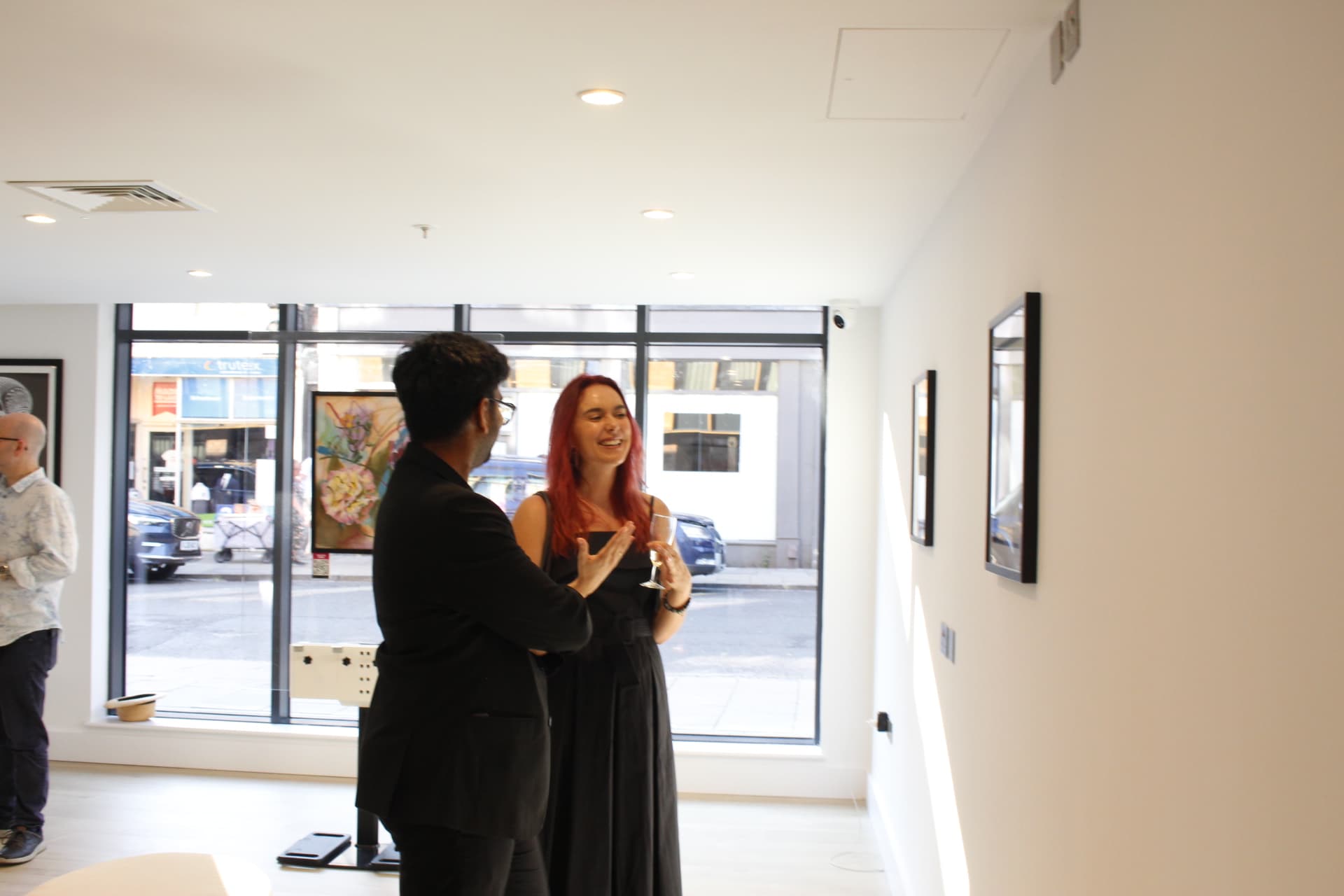
Artist Ufy Art speaking with visitors while selling art in person at our Supercity x KineticAi Opening
Choose the Right Work for the Setting
Before thinking about labels, payments or sales conversations, think about what you are actually going to show.
Different settings create different experiences for buyers.
At an open studio, visitors are entering your working environment. They may be interested in sketches, studies and works in progress alongside finished pieces, and you have more opportunity to explain your process.
At an art fair, you are competing for attention in a busy environment. Your display needs to communicate who you are quickly, and a cohesive selection can make your practice easier to understand.
At an exhibition, the curatorial context may determine which works are included, but you still need to think about how someone who wants to buy a piece will access the relevant information.
Longer-term displays in cafés, restaurants, hotels, shops or workplaces present a different challenge again. Your work may be seen repeatedly by people who were not actively looking for art, and you are unlikely to be standing beside it when someone becomes interested.
When selecting work, ask yourself:
- Does this selection represent my practice well?
- Does it make sense in the space available?
- Are the works actually available to purchase?
- Can each piece be safely displayed?
- Do I know the price, dimensions and delivery arrangements for every work?
You do not necessarily need to show everything. A smaller, considered selection can often be stronger than trying to fit your entire portfolio into one space.
If you are looking beyond traditional galleries for places to exhibit, our guide Can I Exhibit My Art Without a Gallery? explores some of the alternatives.
How to Prepare Art for an Exhibition
Knowing how to prepare art for an exhibition means thinking beyond making the artwork itself.
Ideally, the practical questions surrounding a piece should already have answers before a buyer asks them.
Start by creating an inventory of everything you intend to show. Record the title, medium, dimensions, year, price and edition information where relevant. Give each piece an identifier if you have multiple similar works.
Then consider presentation. Paintings and other 2D works do not necessarily need to be conventionally framed, but they should feel finished and be safe to display. If a work requires specialist fixings, a French cleat or another hanging system, sort this before installation rather than improvising at the venue.
You should also decide how collection or delivery will work if something sells. Can the buyer take the piece immediately? Does it need to remain until the exhibition ends? Will you deliver it, arrange a courier or expect collection?
These details may seem administrative, but uncertainty at the point of purchase creates friction.
Finally, understand any costs attached to the event. An art fair might charge a stand fee. A venue may take commission. A payment provider may charge transaction fees. Work backwards from your selling price so you know what you will actually receive. It's also important to keep the same artwork consistently priced across your website, exhibitions and venue displays, and to agree any discounts with the venue in advance.
If pricing is something you struggle with, read Why Pricing Your Art Feels So Difficult.
Selling Art at Art Fairs
Selling art at art fairs deserves some additional preparation because the environment can be intense.
Visitors may see hundreds of works in a single day, so your display needs to communicate quickly.
Before the fair, check exactly what is included with your stand. Find out about wall dimensions, fixings, lighting, furniture, power access, Wi-Fi and any restrictions on signage.
Bring everything you might need to make a sale, including packaging materials, business cards or contact information, payment equipment and a clear record of your inventory.
Think about different buyer budgets as well. If it makes sense for your practice, having works at more than one price point can give visitors different ways to collect your work. That does not mean creating cheaper work purely for the sake of it. Prints, editions, studies or smaller originals may already provide a natural range.
Most importantly, make it easy to tell what is still available. If something sells, update your records immediately.
A red dot may communicate a sale within the art world, but not every visitor will know what it means. Clear information is better than assuming your audience understands gallery conventions.
How to Display Art for Sale
Learning how to display art for sale is partly about aesthetics and partly about information.
You want the work to look good, but you also want someone to understand what they can buy.
Give artworks enough physical space where possible. Crowding too many pieces together can make individual works harder to notice, while thoughtful spacing gives each piece room to hold attention.
Lighting matters too. Check the space at the time of day visitors will actually be there. Look for glare across framed work, dark corners and strong shadows. At an art fair, do not assume the venue lighting will present your work at its best.
Think about sightlines. What does someone see first when they enter? Is one strong work able to draw them towards your display?
Then consider labels.
At a minimum, an artwork label should make it easy to find:
- Artist name
- Artwork title
- Medium
- Dimensions
- Price or clear purchase information
You may also include the year and edition information where relevant.
A good example of this is a recent PickArt Indie placement of Peta Jacobs' work at Science Creates in Bristol. The venue created its own labels to maintain a consistent visual identity across the wider collection, while still including the key artwork information and incorporating PickArt Indie QR codes. This meant the labels felt cohesive within the space while giving visitors a direct route from viewing the work to finding out more and purchasing it online.
Do not make people work unnecessarily hard to discover whether something is for sale or how much it costs. A potential buyer may feel uncomfortable asking for a price, particularly if they are new to buying art.
Clear pricing can remove that uncertainty immediately.
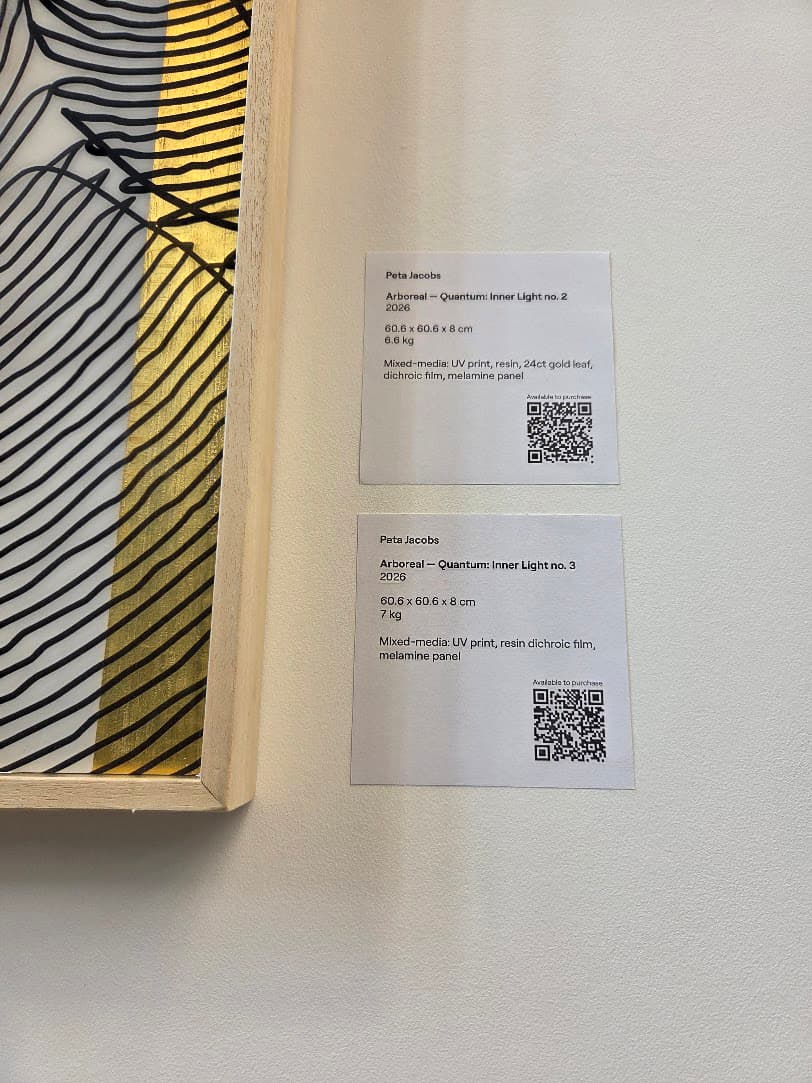
Peta Jacobs' artwork professionally displayed for sale at Science Creates Bristol with clear information labels & using PickArt Indie QR codes to streamline the purchase process.
How to Get People to Buy Your Art Without Pressuring Them
One of the more uncomfortable parts of selling in person can be knowing what to say.
Artists sometimes feel they need to choose between aggressively selling their work and leaving visitors completely alone. There is a much more natural middle ground.
Start with conversation rather than a pitch.
If somebody has stopped in front of a work, give them time to look. A simple greeting or "let me know if you'd like to know anything about the piece" creates an opening without demanding engagement.
If they are interested, you can talk about the work's story, materials, process or the ideas behind it.
This is where selling in person has a genuine advantage. Someone is not just seeing an image on a screen. They can see scale, texture and detail, and potentially speak directly to the person who created it.
The goal is not to persuade every visitor to buy something. It is to make it easy for an interested person to develop a stronger connection with the work.
Pay attention to the questions people ask, too. If several visitors ask whether a work is available, where the price is or whether you ship, that is useful information. Something in your display or purchase journey may not be clear enough.
And remember that "I love this" is not always followed immediately by "I'll buy it."
People may need to measure a wall, speak to a partner, think about the cost or simply leave the busy environment before deciding. Make sure that interest does not disappear just because they walk away.
Make Buying Your Art as Straightforward as Possible
If you are wondering how to get people to buy your art, one of the most useful questions is: how many steps are you asking them to take?
Imagine someone discovers your work at an exhibition and loves it.
They cannot see a price, so they photograph your name. Later, they search for your Instagram. They find the right account, scroll around looking for the artwork, send you a message asking whether it is available, wait for a reply, ask how to pay and then arrange the purchase separately.
Every additional step creates another opportunity for that person to get distracted, forget or change their mind.
Where possible, give buyers a clear route from interest to action.
If you are physically present, that might mean having a card reader or another simple payment method ready. Make sure you know what information you need from the buyer and be prepared to provide a receipt or confirmation.
If you are not going to be there throughout the exhibition, this becomes even more important.
The visitor should still be able to identify the artwork, understand the price, learn about you and know how to purchase it without relying on venue staff to act as salespeople.
Using QR Codes to Connect Physical Art With Online Purchasing
A QR code can be useful in this situation, but only if it leads somewhere useful.
A QR code that sends someone to your general Instagram profile still leaves them searching for the work they are standing in front of. Ideally, it should take them directly to information about that specific artwork.
This is one of the reasons we created PickArt Indie.
Indie is designed for artists who have arranged their own physical display opportunities, whether that is an exhibition, open studio, café, restaurant, hotel, workplace or another space.
Each displayed work can have its own digital artwork page and QR code, allowing someone standing in front of the piece to access its information, price and purchase route. PickArt then provides the checkout and manages the buyer journey.
It does not replace the work involved in finding the right place to exhibit. Instead, it helps connect a physical placement you have already created with a clearer route to purchase.
That distinction is important. A QR code cannot create interest in your artwork, but it can make it much easier for existing interest to become an enquiry or sale.
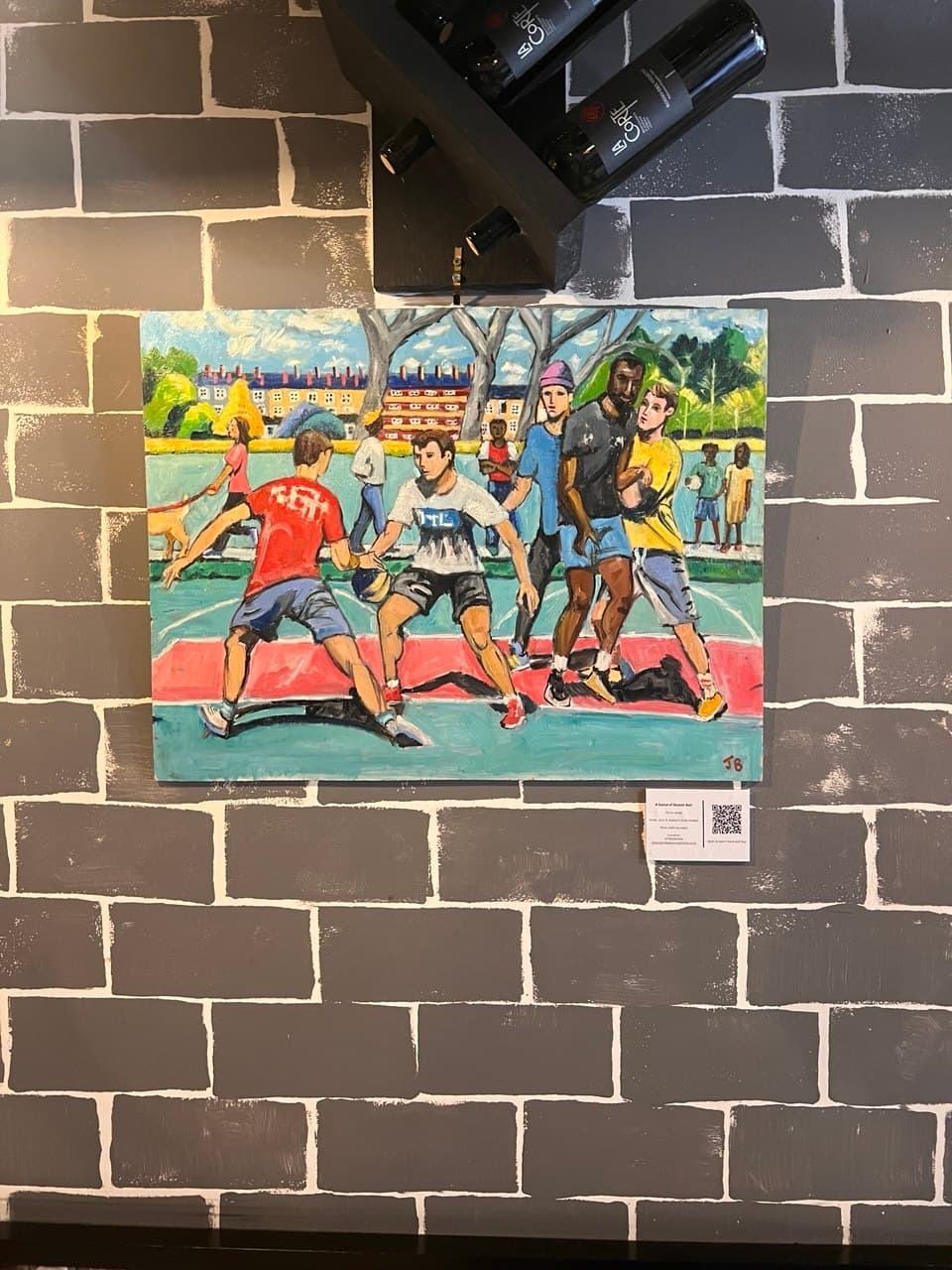
JR Bateson artwork on display in Brixton with PickArt Indie QR code linking visitors to purchase information
For more on independent venue placements, see How to Sell Art in Cafés and Restaurants and Can I Exhibit My Art in Cafés, Hotels or Shops?.
Do Not Lose the Sale After the Event
Not every in-person art sale happens in person.
Someone might spend twenty minutes talking to you at an open studio, leave without buying anything and contact you three days later.
That is why follow-up matters.
Give interested visitors an easy way to find the specific work again. If someone has explicitly asked you to contact them, make a note and follow up while the conversation is still fresh.
Keep the message personal and useful rather than immediately pushing for a decision. You might send the artwork details, dimensions, price and a clear image, particularly if they mentioned needing to check whether it would work in their home.
You can also invite visitors to join your mailing list or follow your work online, but ask rather than automatically adding contact details to marketing lists.
If you also sell through digital channels, Instagram, Etsy or QR Codes? The Best Ways to Sell Art Online covers how different online routes can support the sales process beyond the physical event.
After the event, review what happened.
Which pieces attracted the most attention? What questions kept coming up? Did visitors understand the prices? Where did conversations tend to end? Did anyone struggle to work out how to purchase?
Even an event with few immediate sales can tell you a great deal about how people respond to your work.
The Best In-Person Sales Journey Is a Simple One
Ultimately, learning how to sell art in person is not about finding a perfect sales script.
It is about reducing the gap between somebody connecting with your artwork and knowing what to do about it.
Prepare your work properly. Present it thoughtfully. Make prices and essential information easy to find. Talk openly about your practice when people are interested. Have a straightforward way to pay. And give people a route back to the work if they are not ready to buy immediately.
Open studios, exhibitions and art fairs all offer something online selling cannot fully reproduce: the experience of encountering an original artwork physically.
Your job is to make sure the practical buying experience supports that moment rather than getting in its way.
Already displaying or preparing to sell your work in person? Explore PickArt Indie to create QR-linked artwork pages and give interested buyers a clear way to purchase during or after the event.