
Writing about your own artwork can be surprisingly difficult. You might know exactly why you made something, how it developed and what it means to you, but putting that into a few sentences for someone encountering it for the first time is another challenge.
For artists preparing work for an exhibition, online listing or sale, a clear artwork description can make a real difference to how confidently someone engages with a piece.
The aim isn't to convince everyone to love your work. It's to help people understand what they're looking at, discover something about how it was made and find the information they need if they're interested in buying it.
A thoughtful description can also offer an emotional entry point. Learning about the memory, feeling or experience behind an artwork might remind someone of something in their own life, creating a personal connection that encourages them to consider living with the piece.
Whether you're describing a painting, photograph, sculpture or mixed-media work, here's how to write an artwork description that feels informative, engaging and true to your practice.

Curatorial Director Olivia Abando presents Rae George's work, placed via PickArt consignment at Supercity, York, accompanied by a PickArt QR code leading to its description
What Is an Artwork Description?
An artwork description is a short piece of writing that introduces an individual artwork to its audience.
It might explain what the work depicts, the materials and techniques used, what inspired it or a particular detail someone might not notice immediately.
For someone considering purchasing the work, it should also sit alongside essential information such as dimensions, medium, framing and availability.
Unlike an artist biography, which introduces the person behind the work, or an artist statement, which explores their wider practice, an artwork description focuses on the individual piece.
It also differs from a physical artwork label. An exhibition label may contain only a title, artist, date and medium, whereas an online artwork description has room to offer more context.
If you're preparing an exhibition, our guide to writing artwork labels explores what visitors need to know when encountering work in person.
How Long Should an Artwork Description Be?
The ideal length depends on where someone is encountering your work. A visitor reading a label in an exhibition needs different information from someone considering a purchase online.
Rather than aiming for a fixed word count, think about how much context will help the reader at that particular moment. The following ranges offer a useful starting point:
| Context | Suggested length | What to prioritise |
|---|---|---|
| Physical exhibition label | 10–40 words | Essential artwork details and a brief introduction |
| Online artwork listing | 75–150 words | Subject, materials, process, context and buyer information |
| Exhibition catalogue | 100–250 words | More developed artistic context and interpretation |
| Social media caption | 30–100 words | An engaging detail, story or starting point |
These aren't strict rules. A minimal drawing may need only a few sentences, while a complex mixed-media work could benefit from more explanation.
What matters is that every sentence contributes something useful.
How to Write an Artwork Description in Five Steps
1. Start With What Someone Can Actually See
Imagine someone encountering your artwork for the first time, without knowing anything about your practice.
What would you want them to notice?
Start with the subject, composition, colour, texture or form. This gives the reader something tangible to connect with before introducing more conceptual ideas.
For example, instead of:
"This painting explores the complexities of contemporary existence."
Try:
"A solitary figure sits beneath a brightly lit window, surrounded by overlapping blocks of blue and orange."
The second version doesn't explain everything about the artwork, but it gives the reader a clear starting point.
For abstract work, you can describe the relationships between colours, shapes, gestures and materials rather than searching for a literal subject.
2. Explain the Inspiration, Intention or Emotion
Once you've introduced the work itself, consider what motivated you to create it.
Was it inspired by a particular place, memory, experience, material or question? Does it belong to a wider series?
This is where your perspective as the artist becomes particularly valuable. A photograph can show someone what the work looks like, but it can't necessarily explain the experience or decisions behind it.
An artwork description can also help viewers find a feeling or experience they relate to. A painting inspired by childhood memories, a familiar landscape or a moment of personal change might resonate with someone for entirely different reasons. That emotional connection can become part of why they want to own the work.
However, the goal isn't to tell people what they should feel. It's to offer enough context for them to form their own relationship with the piece.
You don't need to reveal every personal detail, and not every artwork needs an elaborate story.
A simple, truthful observation is more useful than a complicated explanation that doesn't feel authentic.
3. Describe the Materials and Process
Materials can tell us a great deal about an artwork, particularly when the way something is made contributes to its character.
You might mention:
- The medium, such as oil paint, acrylic, charcoal, photography or ceramics.
- The surface or support, such as linen, paper, wood or aluminium.
- Techniques that influence the finished work, such as layering, carving, collage or repeated mark-making.
- Unusual materials or processes that may not be immediately visible.
Try to connect these details to the actual artwork.
For example:
"The artist builds thin layers of oil paint over a textured ground, allowing earlier marks to remain visible beneath the final image."
This communicates more than simply listing oil on canvas, while still being accessible to someone unfamiliar with painting techniques.
You don't need to describe every stage of production. Focus on what helps someone understand the finished piece.
4. Include the Practical Details Buyers Need
If you're wondering how to describe a painting to sell, remember that an engaging description is only part of the picture. While the story behind an artwork can help someone connect with it, clear practical information helps them decide whether it's right for them.
For an artwork offered for sale, make sure the accompanying listing identifies:
- Title, artist and year of creation.
- Medium and materials.
- Dimensions, with units clearly stated.
- Whether the work is an original or part of an edition.
- Framing or presentation details.
- Any relevant information about edition numbers, signatures or certificates of authenticity, where applicable.
Price, availability, delivery arrangements and a clear purchase option should also be easy to find on the artwork page.
Not all of this information needs to sit inside the descriptive paragraph. In fact, separating technical specifications from the more expressive description can make both easier to read.
A buyer shouldn't have to search through a poetic description to discover whether a painting is framed or how large it is.
5. Keep Your Own Voice, but Write for Someone New to Your Work
One of the challenges of writing an artwork description is finding a balance between artistic expression and clarity.
You don't need to abandon your voice or make your work sound simpler than it is. But it's worth considering whether someone encountering your practice for the first time would understand what you've written.
Avoid relying on specialist terminology unless it adds something meaningful, and be cautious with exaggerated claims such as unique masterpiece, investment opportunity or a work that will transform any space.
These phrases don't help someone understand the artwork and can undermine the credibility of an otherwise thoughtful description.
When I'm reviewing artworks for placement, I'm not looking for a description that tells me how impressive a piece is. I'm looking for something that helps me understand what the artist has made, the decisions behind it and what someone encountering it for the first time might want to know. Specificity is far more compelling than exaggerated language.
It's also useful to distinguish between what you intended and what viewers might experience.
You can explain that a painting emerged from feelings of isolation, for example, without insisting that everyone who sees it must interpret it as lonely.
An artwork description should create an entry point, not dictate a response.
A Simple Artwork Description Template
If you're unsure how to describe your artwork, start by breaking it down into a few simple elements: what someone can see, what inspired it, how it was made and what makes it distinctive. Use the template below as a starting point.
Copyable Artwork Description Template
[Artwork title] is a [medium and type of artwork] depicting or exploring [subject, visual elements or central idea].
Inspired by [place, experience, memory or question], the work considers [intention, emotion or theme, if relevant].
Created using [materials or techniques], it features [specific detail about colour, texture, composition or process].
Artwork details
- Artist: [Name]
- Title: [Title]
- Year: [Year]
- Medium: [Materials]
- Dimensions: [Height × width × depth, where applicable]
- Original or edition: [Specify]
- Framing or presentation: [Specify]
- Additional information: [Only if relevant]
You don't need to use every sentence, or follow this order exactly.
Think of the template as a checklist of useful information rather than a formula every artwork must fit.
Real Artwork Description Examples From PickArt
Looking at how other artists describe their work can help you develop your own approach. The following examples are drawn from artworks listed in the PickArt catalogue, demonstrating different ways of communicating visual detail, inspiration and artistic intention.
Example 1: Describing a Painting Through Visual Detail and Atmosphere
Under Putney Bridge II by Margaret Knott
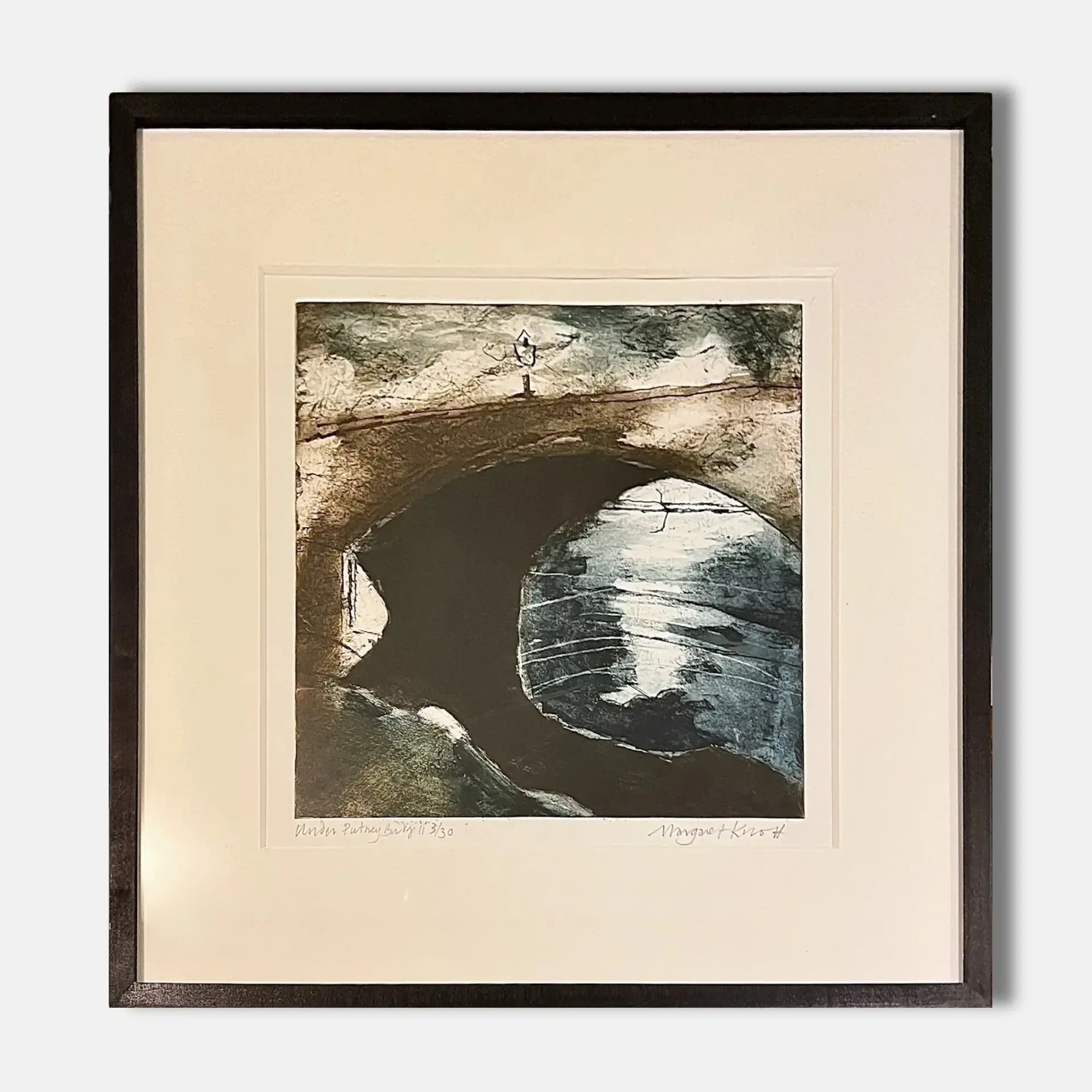
Margaret Knott, Under Putney Bridge II, 2018, graphite and gouache on paper
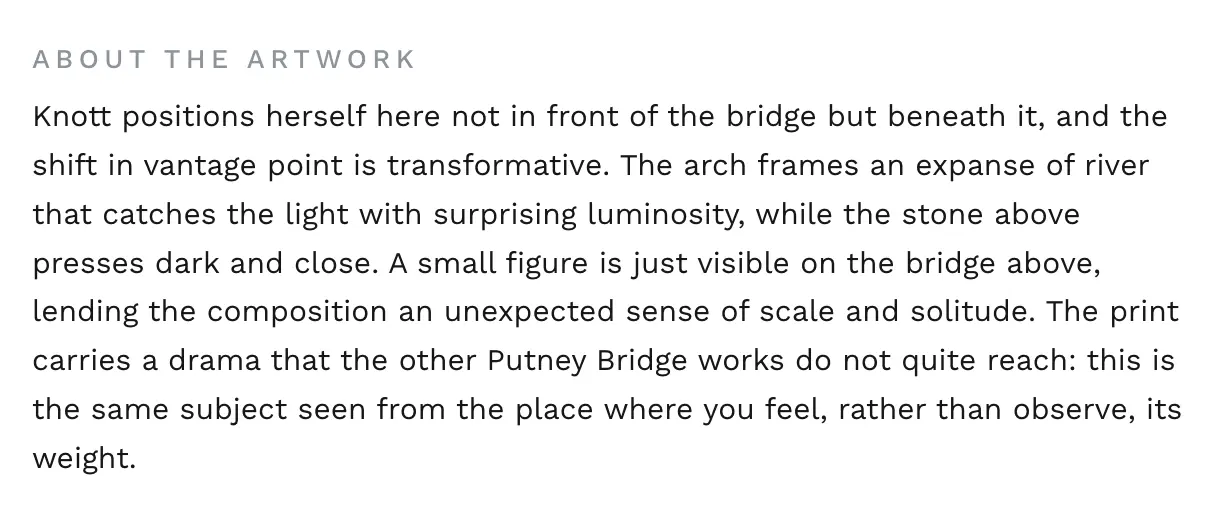
Margaret Knott's description focuses on the experience of viewing Putney Bridge from beneath its structure.
Rather than simply identifying the subject as a London landmark, the text draws attention to the contrast between the darker stone overhead and the light reflected on the river. It also identifies a small figure on the bridge, introducing a sense of scale and solitude.
Why this works: The description connects specific visual details with atmosphere. It helps the reader notice how the composition influences their experience of the work, while leaving room for their own interpretation.
This is particularly useful when describing a landscape or representational artwork. Instead of relying on broad terms such as beautiful scenery, consider what makes your particular view distinctive.
Example 2: Describing Abstract Artwork Through Inspiration and Feeling
Wave Forms in Blue and Green (Waimānalo Beach) by Libby Hoffenberg
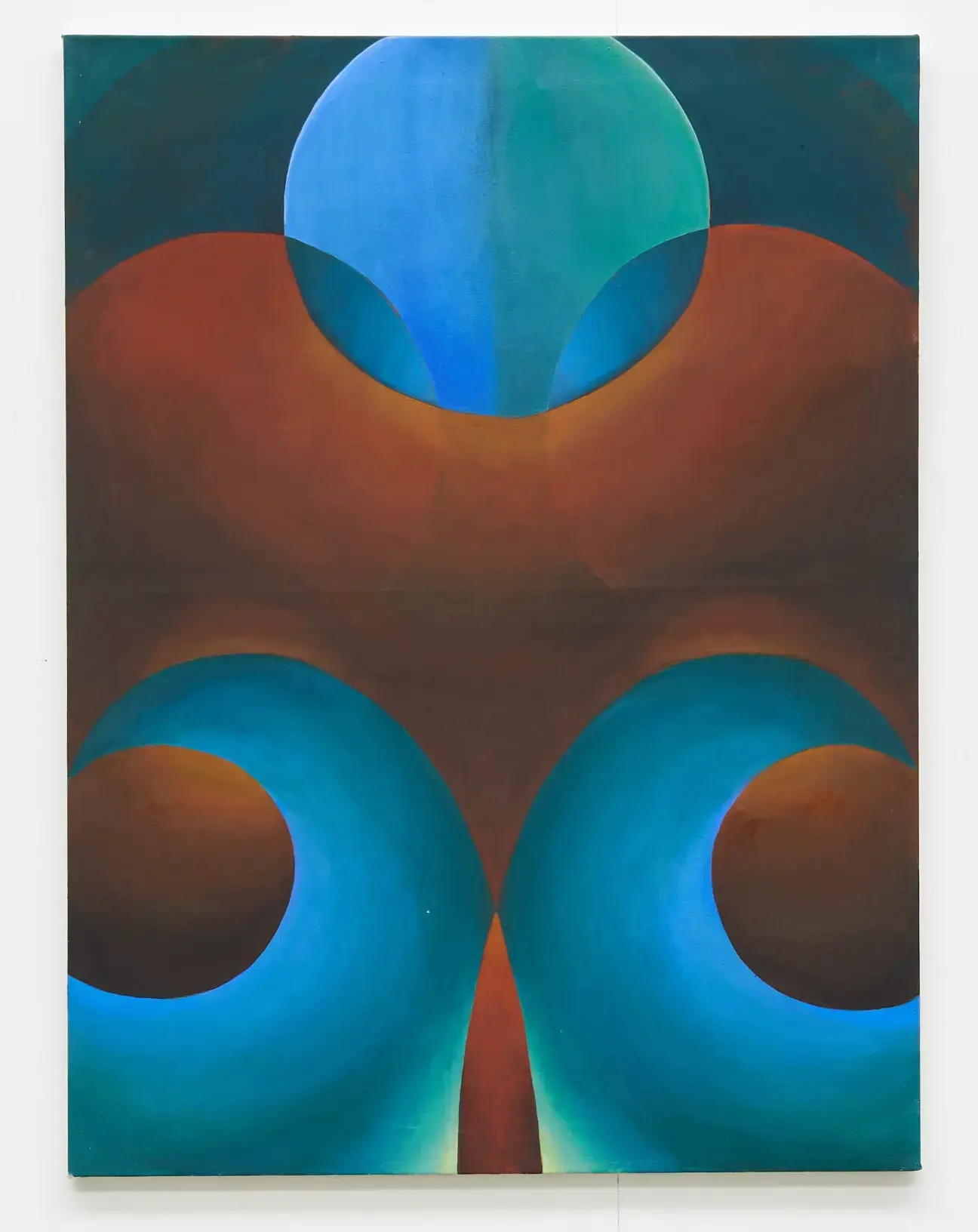

Libby Hoffenberg, Wave Forms in Blue and Green (Waimānalo Beach), 2024, oil on canvas
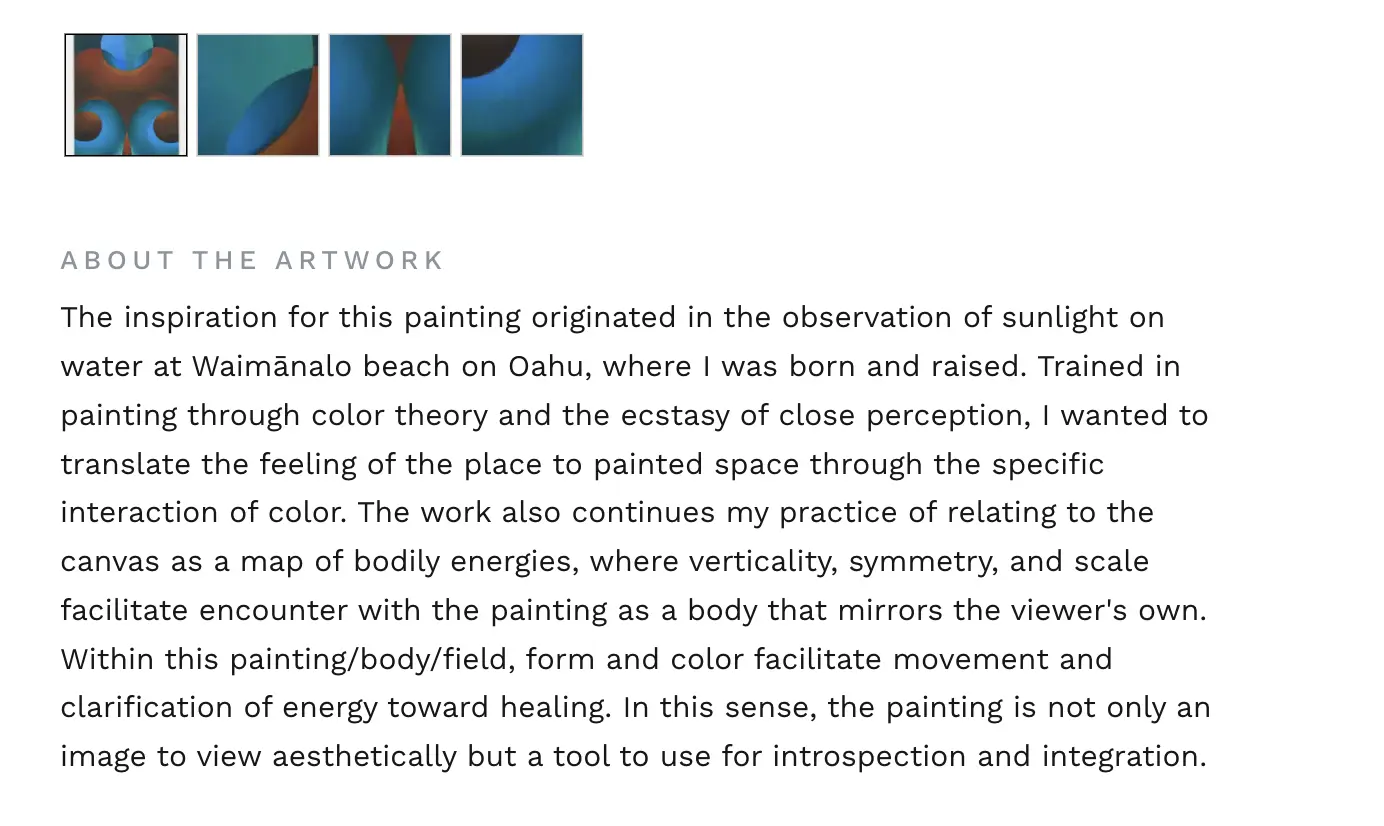
In the artwork's description, Hoffenberg explains that the painting was inspired by observing sunlight on water at Waimānalo Beach in Oahu, where she was born and raised.
She connects this personal experience to her interest in colour, perception and the relationship between painting and the body.
Why this works: The description provides a personal point of entry into an abstract artwork without reducing it to a literal image.
Knowing where the inspiration came from gives viewers something relatable to consider, while the explanation of colour and form offers insight into the artist's intentions.
It's a useful reminder that abstract art can be described through observation, memory and experience, even when it doesn't depict a recognisable subject.
Example 3: A Concise Painting Description
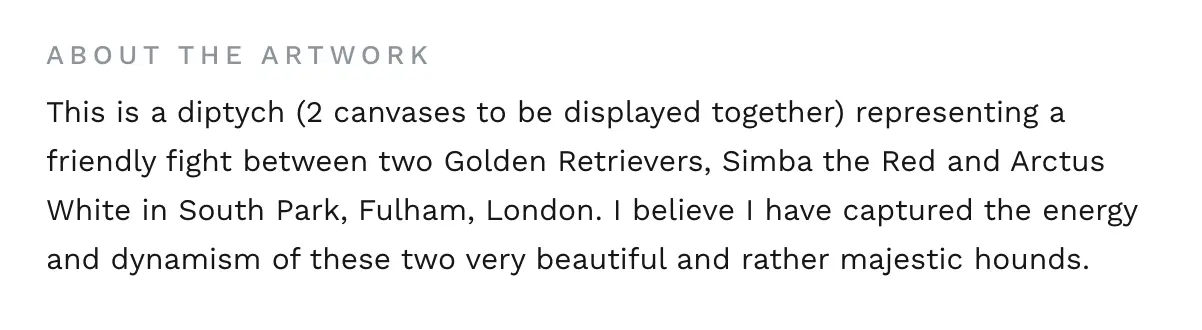
Battle of South Park by Daniel d'Arlay
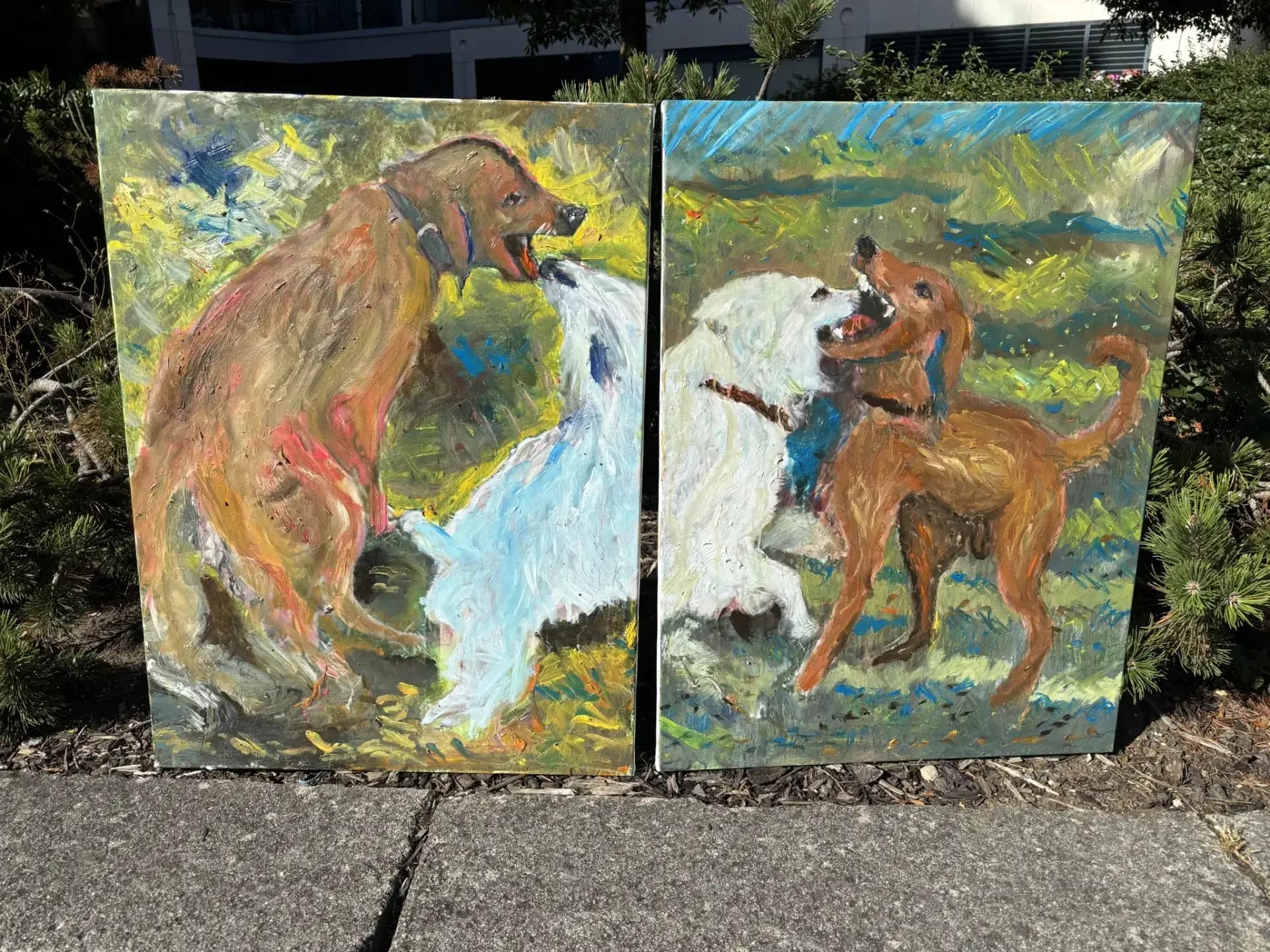
Daniel d'Arlay, Battle of South Park, 2026, oil on canvas
Daniel d'Arlay describes a diptych depicting two Golden Retrievers, Simba and Arctus, playfully interacting in South Park, Fulham.
The description identifies the subjects, the setting and the artist's intention to capture their movement and energy.
Why this works: It shows that a description doesn't need to be lengthy to be effective. The specific details, including the diptych format, the two named dogs and their location in South Park, Fulham, give readers a clear sense of the artwork and its inspiration.
The description does lean on subjective language, describing the dogs as "very beautiful and rather majestic", but it's the specific details that make it informative and engaging. This is a useful reminder that personal expression has its place, but descriptive detail often communicates more than praise alone.
Before and After: Improving a Vague Artwork Description
Sometimes the easiest way to improve your writing is to look at what isn't working.
Before
"This beautiful and unique abstract painting is inspired by my emotions and explores the human experience. It would look amazing in any home and is perfect for art lovers."
The problem isn't that the artist has an emotional connection to the work. It's that the description doesn't tell us much about the actual artwork.
Words such as beautiful, unique and amazing are subjective, while the human experience is too broad to communicate a specific intention.
After
"Made using acrylic and charcoal on canvas, this abstract painting combines broad washes of blue with dense, overlapping black marks. The work developed from a series of drawings made during a period of personal change, with repeated gestures reflecting the artist's interest in uncertainty and movement. Areas of exposed canvas create pauses between the more heavily worked sections."
This fictional example introduces materials, visual qualities, process and inspiration.
It doesn't promise that the viewer will feel a particular way or suggest where the painting belongs. Instead, it provides information that allows someone to develop their own connection with it.
Common Mistakes to Avoid
When reviewing your artwork description, ask yourself whether you've fallen into any of these habits.
Being too vague. Words such as expressive, powerful or thought-provoking can be useful, but only when supported by specific details.
Overexplaining the meaning. Not every symbol or artistic decision needs to be decoded. Leave room for the viewer's interpretation.
Using unnecessary jargon. Technical language is valuable when accurate and relevant, but it shouldn't become a barrier to understanding.
Writing only about yourself. Your wider practice matters, but an individual artwork description should remain focused on the piece being presented.
Forgetting practical information. An interested buyer still needs to know the size, materials, presentation and purchase details.
Before publishing, try reading your description aloud. If a sentence sounds unnatural or doesn't add anything useful, consider simplifying it.
You can also ask someone unfamiliar with your practice to read it and explain what they understood.
Putting Your Artwork Description to Use
Once you've written a description, the next step is making sure people can find it when they encounter your work.
An effective artwork listing brings several elements together: clear photographs, accurate artwork details, an engaging description, transparent pricing and an accessible way to purchase.
These details become particularly valuable when you're showing work outside a traditional gallery environment.
Whether you're organising an Open Studio, exhibiting independently or displaying artwork in a café or workplace, someone may connect with a piece without having the opportunity to speak to you directly.
Making information accessible allows that interest to develop beyond the initial encounter.
Our guides to selling art in person, selling art online and exhibiting without a gallery explore different ways artists can create these opportunities.
Bringing Your Artwork Descriptions Together With PickArt Indie
PickArt Indie is designed for artists who are organising their own opportunities to display and sell original physical artwork.
Artists can create individual artwork pages with images, descriptions, pricing and online checkout, then connect those pages to the works on display through QR codes.
Crucially, this means artists don't need to become web developers to sell their work. Rather than building individual product pages, integrating payment systems or developing their own online shop, they can use Indie's existing tools while focusing on creating and exhibiting their artwork.
Someone discovering a piece in person can then learn more about it and explore purchasing it without needing to track down the artist or ask the venue for details.

Artworks by Peta Jacobs placed via PickArt Indie, with a QR code leading to a detailed description and streamlined sale page
A good artwork description doesn't guarantee a sale, but it can help someone move from curiosity to a more informed decision.
And that starts with something simple: giving people the information they need to connect with the work on their own terms.
Ready to put your artwork description to use? Explore PickArt Indie to create an artwork page with images, details, pricing and checkout, connected to your displayed work through a QR code.